Scout: Competitive Intelligence at Scale
Leading design strategy for Yext’s newest product: Scout.
ROLE:
SR PRODUCT DESIGNER
COMPANY:
YEXT
TIMELINE:
JAN - DEC 2025
SCOPE:
New product offering (ideation→launch→ongoing)
OUTCOMES:
$5.9M in generated revenue • 175 customer purchases
Designed and launched net-new competitive intelligence product in ~8 weeks
Led design strategy across data visualization, insights, and AI recommendations
Aligned executives, product, engineering, and research on a shared product vision
Drove $5.9M ARR within the first year post-launch
Overview
The Yext platform stores and manages data for hundreds of thousands of customer locations worldwide. With a product suite that includes Reviews, Social, Pages and more, it’s able to track and analyze limitless data points, letting customers know exactly how they are performing in the digital space, within their industry and even against branded competitors.
Introducing Scout
Yext’s newest product Scout brings data, insights and recommendations to the forefront of the Yext platform so that users can prioritize the opportunities that are most impactful for their business.
Problem
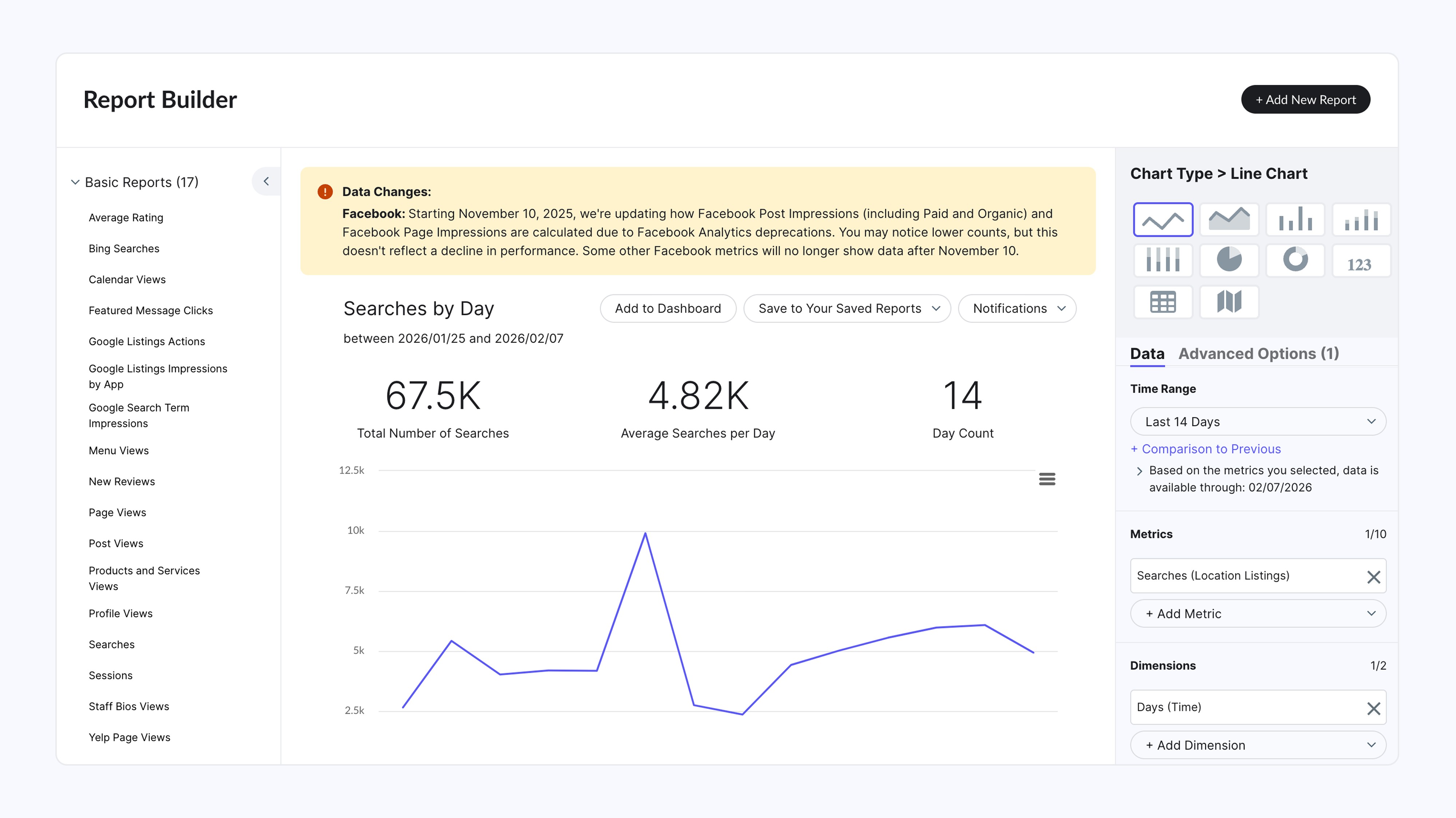
The majority of Yext customers need either educated “power users”, or Yext Services hours to navigate the platform and sift through the numbers. The problem is not a surprising one to those of us familiar with the Yext platform:
Yext data is too complicated for users to confidently take action.
Today, 183 Yext Customers pay for at least 5 monthly services hours, usually for easy tasks that they should be able to do themselves.
— Yext Employee
We have this treasure trove of data, but Client Success Managers (CSMs) are spending hours every week looking for trends to bring to their client calls… it’s very inconsistent; [a customer’s] performance with Yext is only as good as [their] CSM.
— Yext Employee
I don’t want to look through the data; I just want to be told what to do.
— Customer
How might we present customer performance in a way that is both intuitive and actionable?
Constraints
Uber H3 Hexagons: map visualizations need to adhere to Uber’s Hexagonal Hierarchical Spatial Index (H3) for the map visualization, to ensure performance at scale and reduce engineering lift
WCAG AA: Scout needs to be fully WCAG AA compliant, essential for enterprise and public-sector customers
Approach
Aligning the team on the shared vision
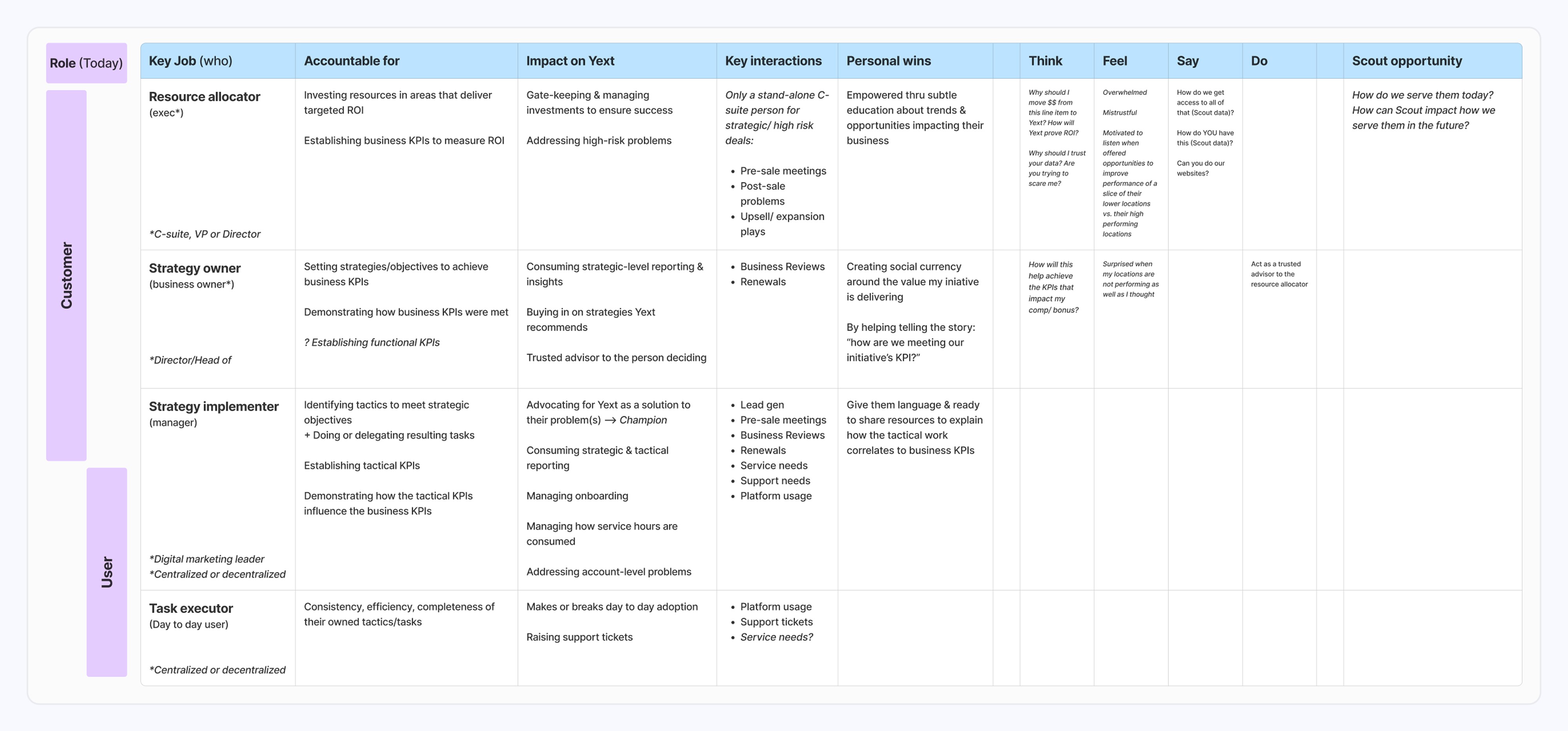
From Day 1, this project was incredibly high visibility, and our team facilitated daily conversations with executive leadership on direction and strategy. To get executive leadership on the same page, I conducted interviews with each stakeholder and synthesized their input into a shared vision document, user personas, and core workflows. These artifacts became the foundation for all subsequent design and product decisions, and enforced that Scout should be:
Intelligent: connecting the dots behind the scenes and surfacing signals before users have to ask
Confident: offering clear, opinionated guidance backed by data
Collaborative: surrendering control and decision-making to the user
Contextual: adapting to the user and their behavior, goals and account purview
Simplifying the data visualization story
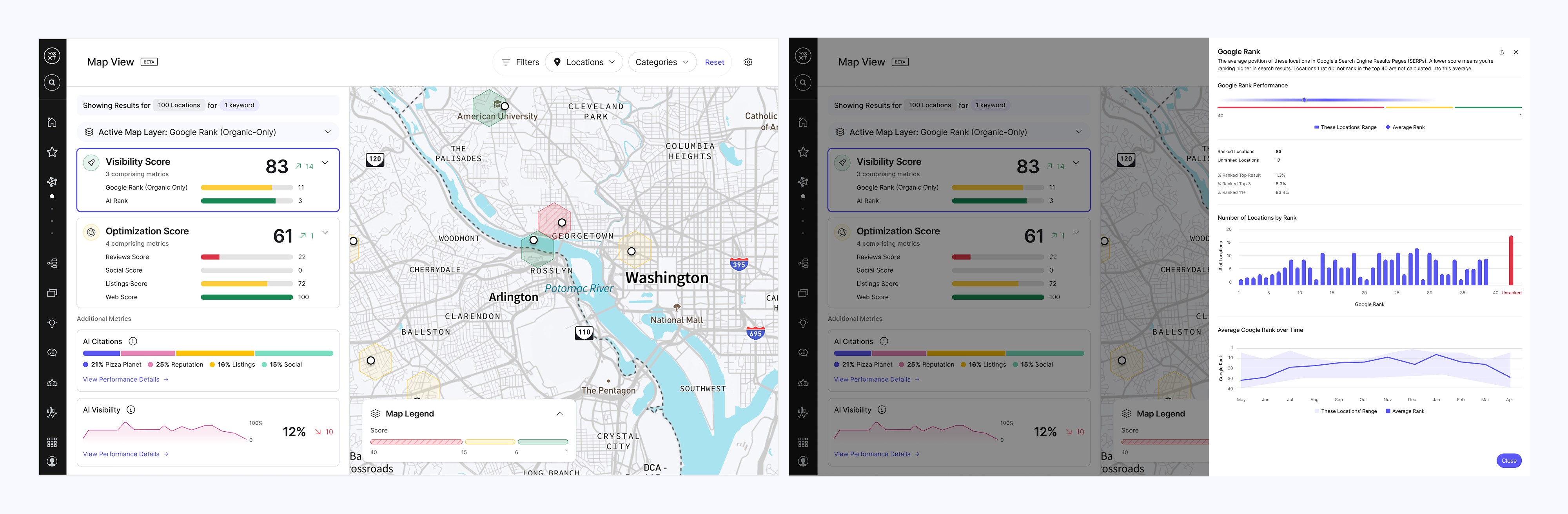
Once the team was aligned, I began design exploration, focusing initially on data visualization. The vast majority of Yext customers are geographically scattered, so the Map became an important focal point to display performance at a high level. My goal was to make complex geographic and metric data instantly legible, so users could identify risk areas and opportunities intuitively and easily.
Creating a design pattern library
One recurring challenge was communicating the complex swaths of data into snippets and summaries that users cared about. Every color, icon indicator and piece of copy needed to be concise, consistent and meaningful in order to quickly relay which data points required the most attention. I documented these decisions in a library so that the team could have visibility, understand design rationale and use the same patterns as needed.
Converting data into insights
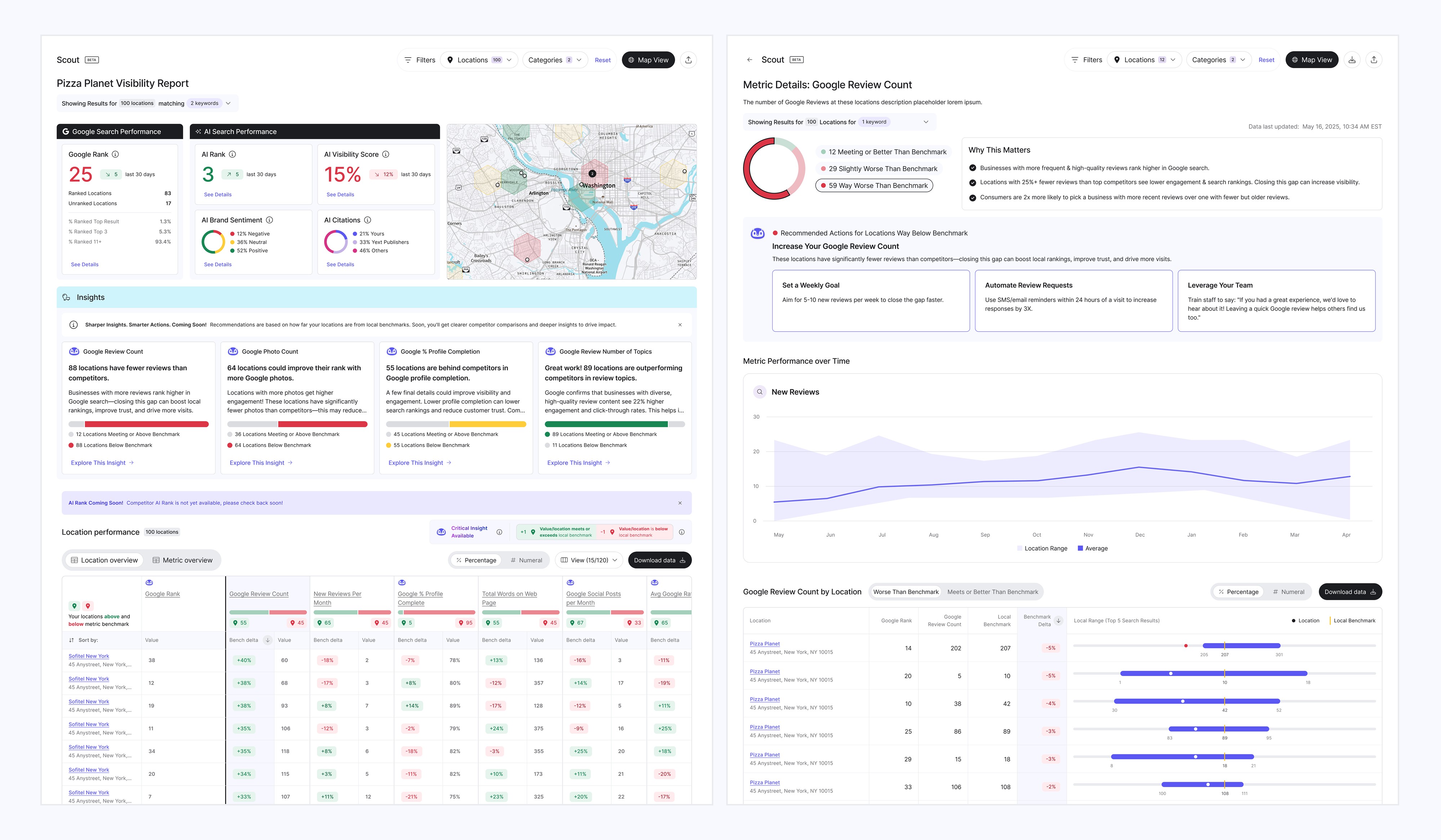
Another key priority was surfacing insights backed by metric data. Using unique benchmark values for each metric and location based on top local competitors, we are able to summarize what proportion of locations are falling below their benchmarks.
Noticing and solving for feature gaps
One product shortcoming I noticed early on is that we were not offering a dedicated space to dive deeper into metric performance. We were displaying insight summaries on the Visibility Report (below left), above a table of metric values, but users were dead-clicking both in order to see more details. I hypothesized that task-executors and delegators would need to access underperforming locations in order to take action or distribute assignments. I took action, presenting this data and a design proposal for a Metric Details page in order to accommodate this user need, and it was added to the roadmap and implemented.
Identifying competitive areas of opportunity
Throughout this project, I had plenty of autonomy and flexibility to explore new features. We heard repeatedly from customers that competitors were a key area of interest, both brand-level and local.
If all my locations are showing up as green, I’m not going to dig any deeper, but if there are nearby competitors starting to ‘eat my lunch’, I want to know about it.
— Customer
…is there a way to see [on the map,] who my biggest threats are?
— Customer
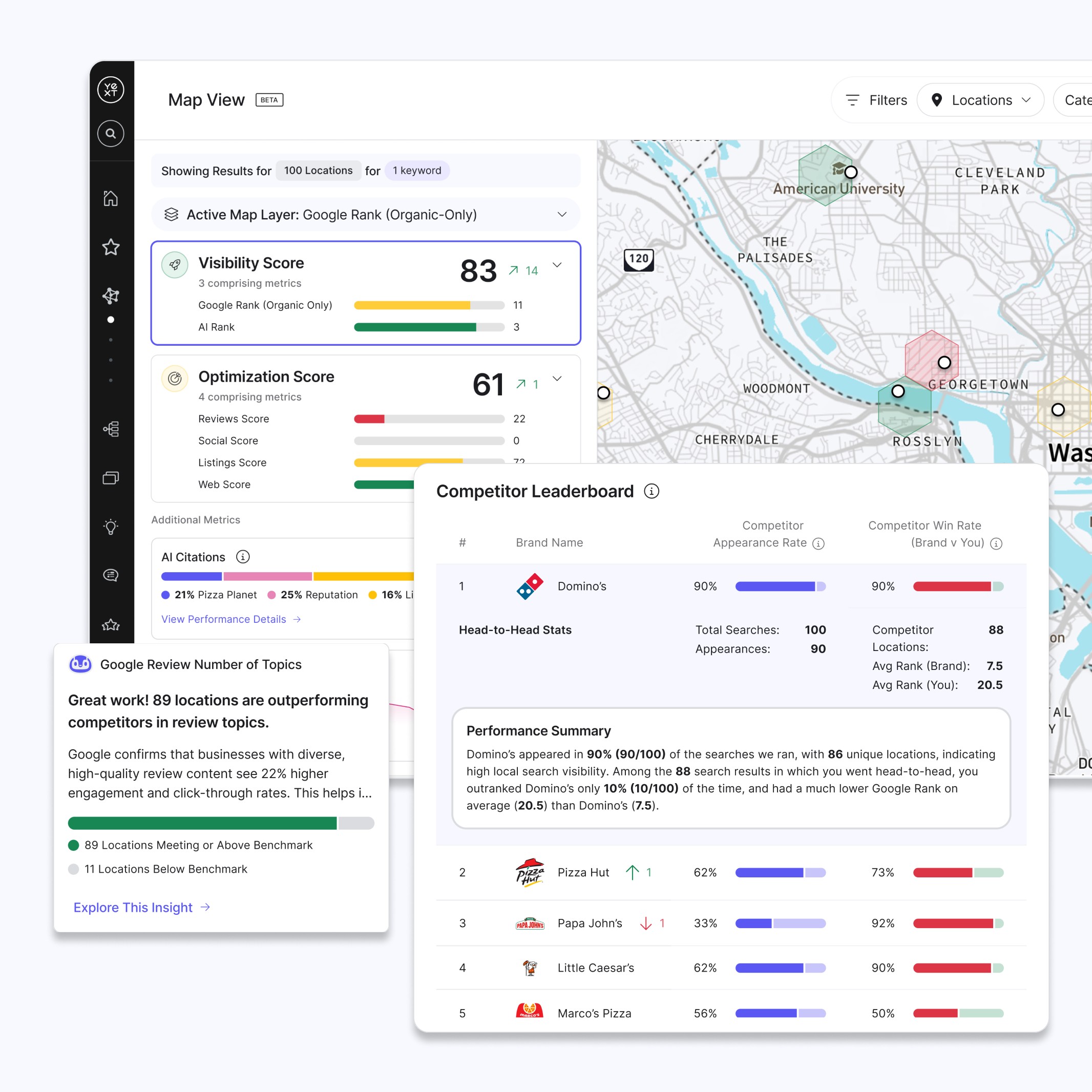
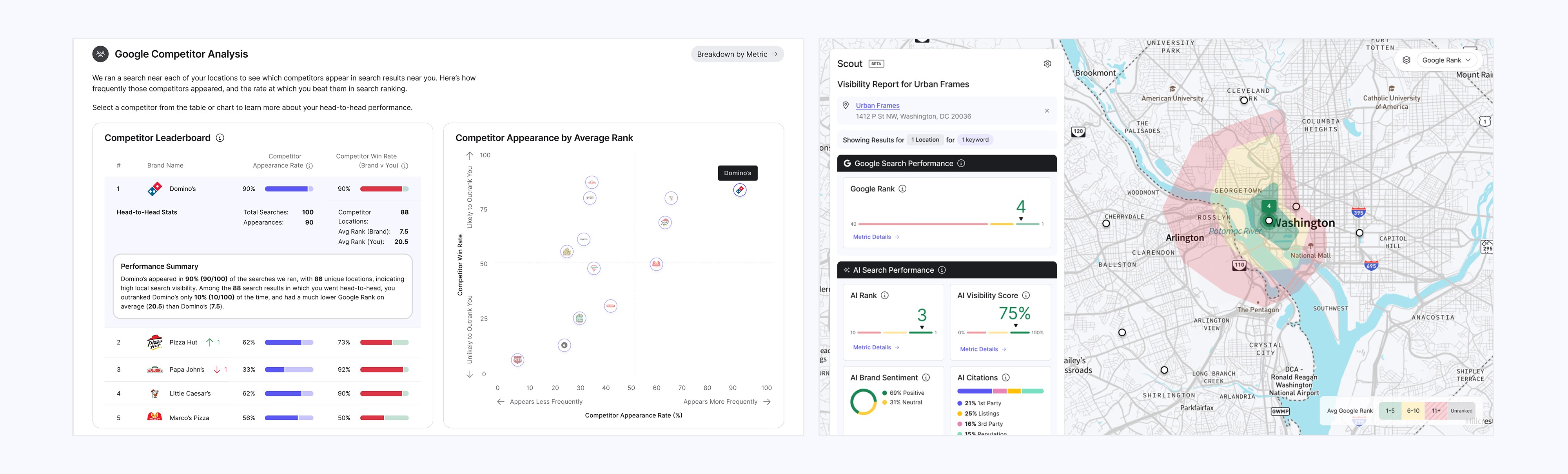
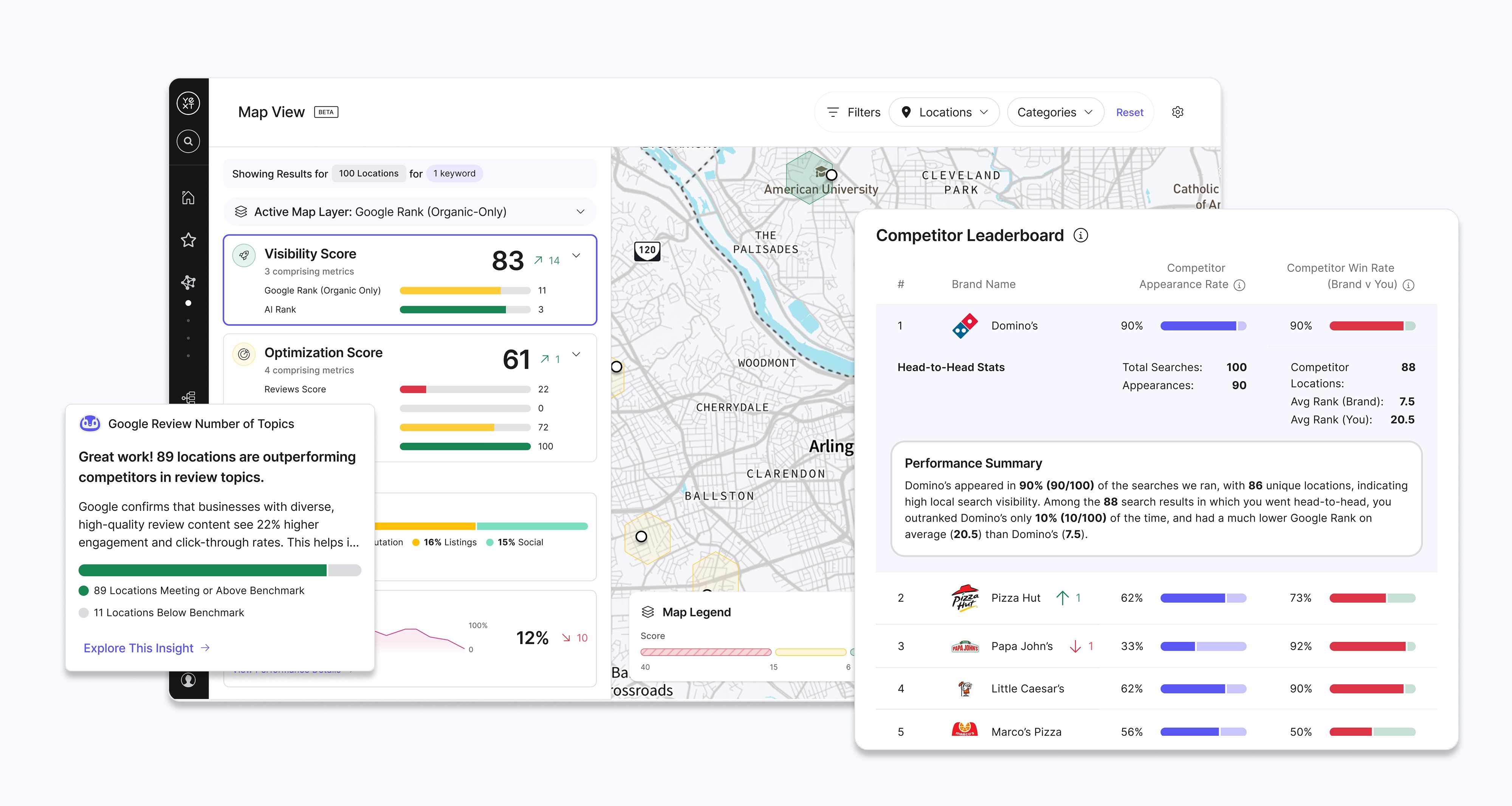
These testimonials led me to explore various designs, namely a competitor leaderboard and an alternate visualization for map view performance (below).
For the leaderboard, I presented brand competitors by threat level, combining their frequency of appearance in search results, and the rate at which its ranking beat that of the customer. As a supplement to the table, I also presented this data as a scatterplot chart, which was confirmed during testing helped users understand that both metrics were contributors to overall threat level.
For the map view, I tested several visualization ideas, finding that organic shapes resonated as the most meaningful to users aiming to understand their Google ranking at the street-level. Using local competitor ranking data, I reverse-engineered this idea to fit with our Uber H3 hexagon visualization, while also informing users of their top threats per location. Both of these side projects were evaluated by the rest of the team and leadership, and are being considered for the roadmap.
Integrating AI to optimize workflows
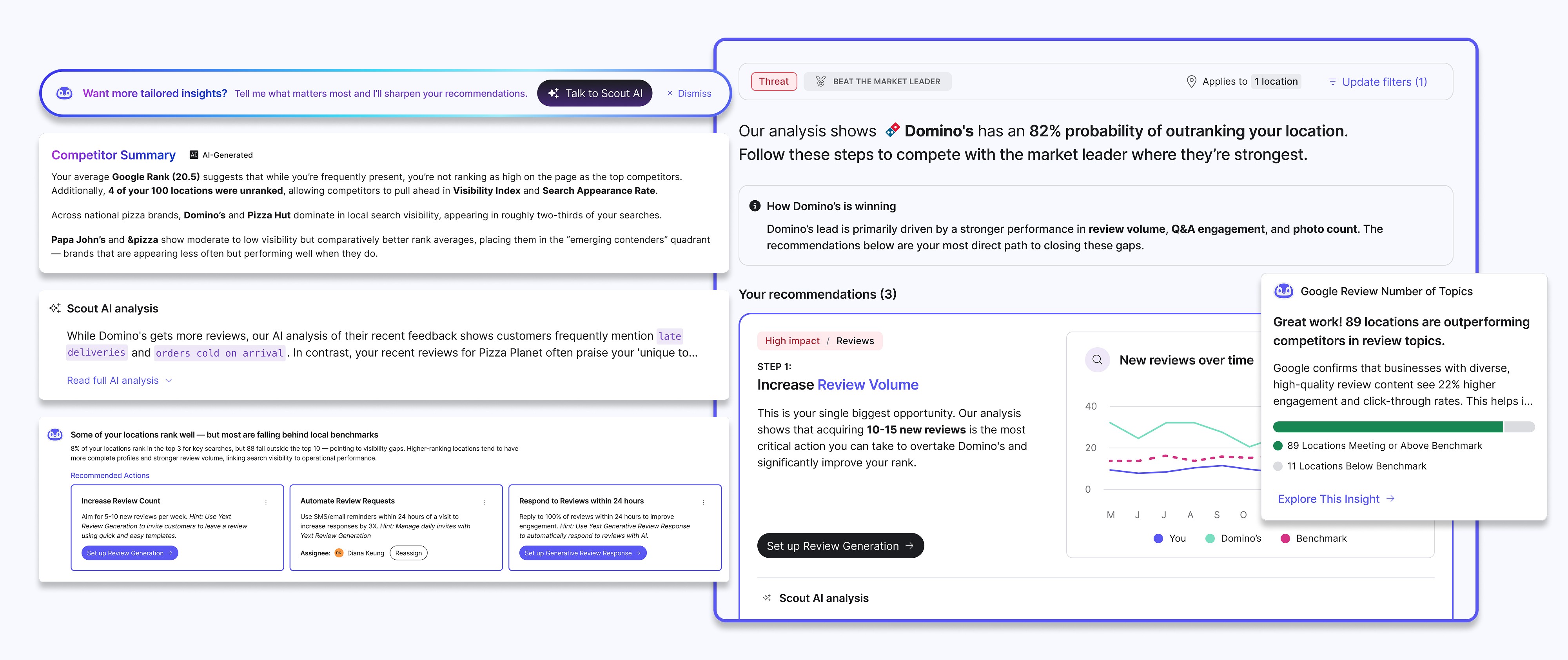
AI is being thoughtfully integrated into every facet of Scout in order to empower users to understand context and take action. Below are some examples where AI actively summarizes the data and guides the user in the most impactful ways possible. These were all prompts that I refined alongside product and engineering to produce consistently reliable generated content.
Solution
A digital performance interface that provides comprehensive data, detailed insights and recommendations that are hyper-local, specific and actionable.
Scout kicked off in January 2025, successfully launched only two months later in March, and has been sprinting ever since. I designed Scout’s first ever interface, made up of a fully functional and accessible map view, a data-rich visibility report and complete with comprehensive insights and AI generated recommendations.
Logging into the Yext platform has historically been a disjointed and overwhelming experience. Scout is a performance hub where users can see brand level performance, dive deeper into location-level granularity, monitor local threats, review summarized data insights and take recommended actions, all in one place.
My foundational design decisions, personas, and workflows continue to guide the team as Scout evolves—ensuring consistency as new designers and features are added. Scout’s maintenance and success is ongoing, and there are many more features yet to be released.
Impact
$5.9M closed won ACV
175 customer purchases of Scout
Since its launch in March 2025, Scout has gained significant traction among Yext customers and across the technology space. Its pilot program garnered more than 250 unique customer sign-ups, and about 175 existing customers have already added Scout to their product suites so far. By making performance data intuitive and actionable, Scout reduces customer reliance on Services hours and empowers customers to engage with the platform and take action at scale.
Scout takes Yext so much farther than the knowledge database it used to be. It gives users a reason to spend time in the platform, diving deeper and understanding more about their own businesses than they ever did before.
Reflection
From day 1, Scout’s roadmap seemed impossibly fast, its vision constantly changing, and its visibility under the watchful gaze of executive leadership. It was the hardest project I’ve ever been a part of.
But it has also been incredibly rewarding. Even in completing this case study, I marvel at what was accomplished in under a year, and how much I learned along the way.
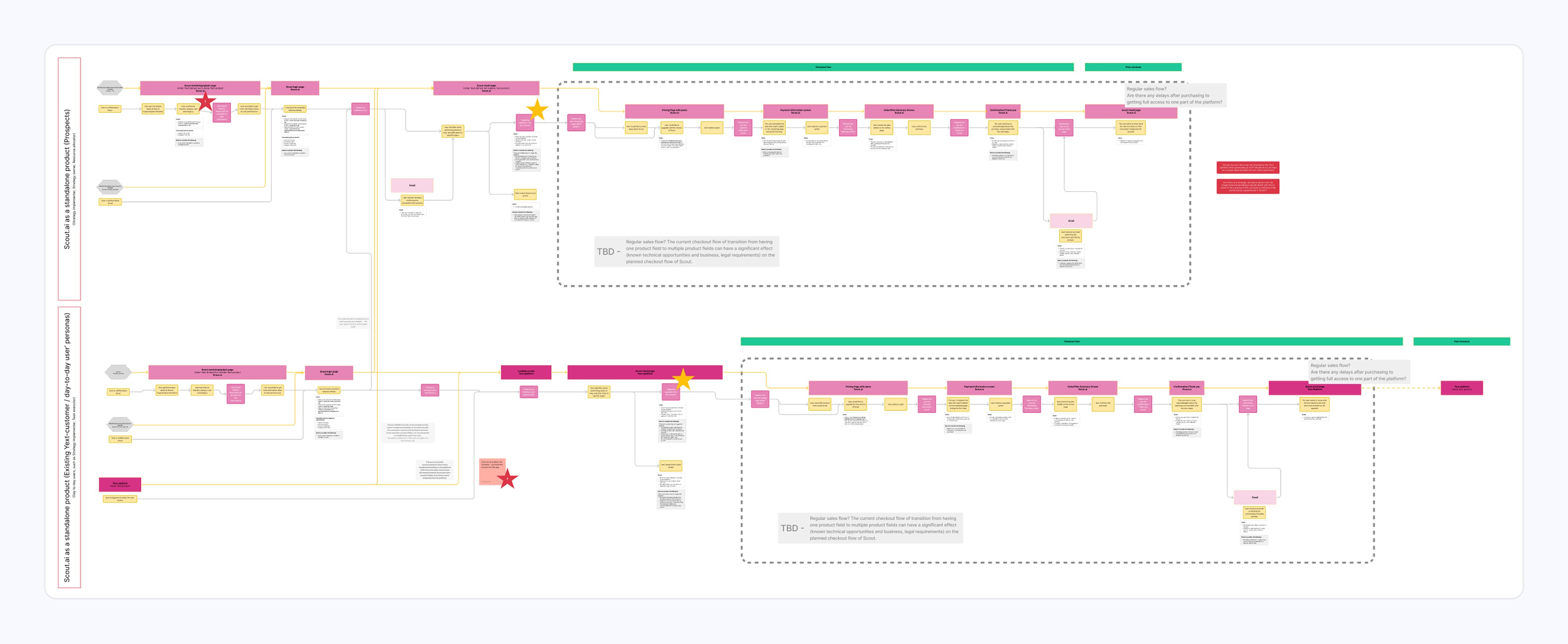
There are countless learnings that I will carry forward into future projects. Scout’s ambiguity from the start meant that alignment and documentation were essential to keep parties accountable and in lockstep. Because we were eager to dive into high-fidelity, many of the user journeys were discombobulated as we added feature ideas. For future projects, I will be sure to emphasize and revisit user flows to ensure more complete and cohesive journeys for the product.
I navigated challenging team dynamics and confrontations with leadership, pursued my own research and exploration, and presented compelling work that I was confident in and passionate about. I am proud to have been a part of the Yext Scout launch, and grateful to have had the opportunity.